
Virtual training is here to stay, but there is so much more to online learning!
Since the start of the pandemic, we have been running all our previous classroom training virtually (i.e. bringing together a group in a live setting for a training session). As per the recent reflection of my colleague in her blog Thoughts from a virtual trainer, these virtual sessions have been well received. In fact, feedback is as good as for the same courses delivered face-to-face, sometimes even better.
Having tried to get clients interested in online learning for a good many years with only mixed results, the Covid crisis has managed to “convert” clients in no time – at least as far as virtual training is concerned!
With greater acceptance of virtual training and its effectiveness by managers and sponsors and building on the positive experience of training participants, we can therefore say with some confidence that a degree of virtual training is here to stay.
I can see a risk though that virtual training will become the ‘go-to’ online training solution in people’s minds. Which would be a pity, because online learning has so much more to offer to the corporate training sector than just virtual training or elearning courses. (See my previous blogs in which I explain the distinctions late last year I explained the distinctions.)
A brief & practical guide to online learning in business – Part 1
A brief & practical guide to online learning in business – Part 2
The most significant benefits of online training are its flexibility and adaptability in the way it can be made to fit around the “day job” and the significant cost reductions achieved by different online learning types without sacrificing the learning experience or learning outcomes.
A Kingsfield Academy study demonstrates the potential cost savings for different types of online programs as illustrated in below figure: Whereas the development costs of good quality online courses and programs are similar to classroom training, the savings come as a result of the number of staff members who can go through certain types of online learning (especially elearning and digital team-based programs), the costs for travel, accommodation and training facilities, but also the opportunity costs that come with absence from projects.
This way an organisation can save up to 70-80% costs on the roll-out of major training programs. Note however, that there is no one-size-fits-all, and the type of online learning solution needs to fit the desired learning aims and training purpose.
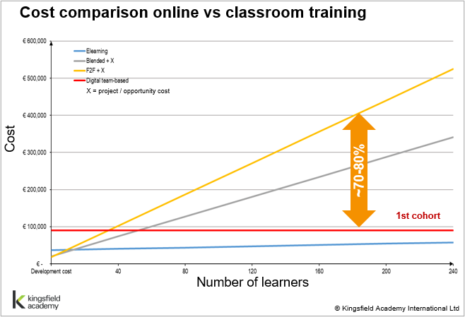
The same level of cost savings cannot necessarily be achieved for virtual training sessions due to the need for smaller group sizes, but virtual training still has plenty of advantages, such as greater flexibility for the participants and their employers, or the ability to create better conditions for the desired learning to become embedded in work practice.
Educational and communication technologies provide us with an almost limitless range of options in how to package, host and present learning content, bring people together, communicate with them, and facilitate their learning.
Just as digitalisation is high on the agenda of our engineering and construction clients, it makes good business sense to broaden the training horizon towards a greater variety of online learning by leveraging these technologies to achieve learning aims, maintain flexibility, and generate optimal cost savings.
What are your experiences of online learning? Do you think we can push out the boundaries to create a greater variety of online training designs?
Gabriele Burian – Managing Partner Kingsfield Academy